
Custom or packaged software: how to evaluate the fit
What does this article explain?
Choose custom or packaged software by comparing workflow fit, total cost, integrations and maintenance responsibility. A pilot helps test the decision.
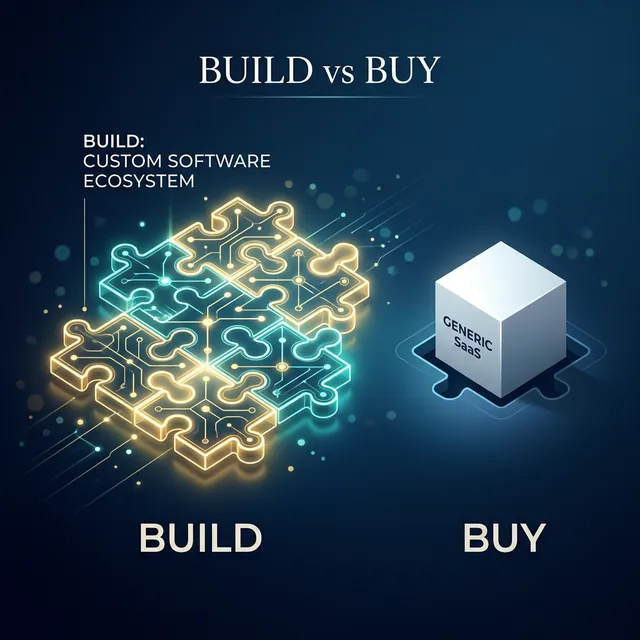
The Illusion of the "Quick Fix"
For the past decade, the tech industry has sold businesses a very convincing story: “Why build your own software when you can just pay a monthly subscription for ours?”
This Software-as-a-Service (SaaS) model seemed flawless. Companies bought an HR system from one vendor, a CRM from another, and an accounting system from a third. It was fast to set up, but fast forward to 2026, and those same companies are hitting a massive wall.
They don't have a unified tech infrastructure anymore; they have a "Frankenstein" system. Disconnected data, employees wasting hours copying numbers from one app to another, and skyrocketing monthly subscription fees that scale exponentially as the team grows.
At Smart Team, we partner with C-level executives who have reached this breaking point. They realize that to truly dominate their market, they can't run their unique business processes on the same generic software their competitors use.
The Hidden Costs of Generic SaaS
When evaluating whether to Buy (Generic SaaS) or Build (Custom Ecosystem), decision-makers often look only at the initial price tag. But the true cost of off-the-shelf software is hidden beneath the surface.
1. The Integration Nightmare
You buy a modern HR software because your team loves the interface. But then you realize it doesn't talk to your legacy payroll system. Now you have to pay a consultant $50,000 to build a fragile API bridge between the two. When one system updates, the bridge breaks. The Custom Advantage: A custom-built ecosystem is designed from Day 1 to mirror your exact data flow. The HR, Finance, and Operations modules share a single brain. No bridges required.
2. "Per-Seat" Pricing Traps
Generic SaaS loves the "per-user, per-month" model. It’s cheap when you have 10 employees. But what happens when you scale to 500? You are effectively being financially penalized for growing your business. The Custom Advantage: With custom software, you own the intellectual property (IP). Adding 1,000 new employees to your system costs you absolutely nothing in software licensing fees. You only pay for the server hosting, which scales affordably.
3. Modifying Your Business to Fit the Software
This is the most dangerous hidden cost. Generic software is built for the "average" company. But your company isn't average; your unique workflow is your competitive advantage. When you buy generic SaaS, vendor representatives will often tell you: "Our system doesn't do it that way, you’ll have to change your internal process." The Custom Advantage: Custom software is molded around your business, not the other way around. It accelerates your existing strengths instead of forcing you into a standard operational box.
The Middleware Era is Over
In the Middle East specifically, organizations deal with unique challenges: highly specific local tax structures (like ZATCA in Saudi Arabia), complex localization requirements, right-to-left UI priorities, and stringent data sovereignty laws.
Global SaaS vendors try to solve this by selling you "localization modules" or relying on local middleware partners. It’s a patch, not a solution.
When your core operations rely on custom architecture developed by a localized, high-tier technical team like Smart Team, you achieve true Digital Sovereignty. You dictate the roadmap. If the local government changes a labor law on a Monday, your custom HR system can be updated by Tuesday—without waiting for a global corporate office in San Francisco to prioritize your feature request.
When Should You ACTUALLY Buy Generic?
To be fair, custom software isn't for everyone. If you are a 5-person startup testing a new idea, absolutely buy an off-the-shelf CRM. Keep your capital agile.
However, if you are an established enterprise, a rapidly scaling operation, or a market leader managing critical operational data, relying on rented, generic software is a major strategic risk.
The Final Verdict: Own Your Core
Your technology is no longer just a "support function." Tech is the business. If you don't own the code that runs your core operations, you don't fully control your company’s future.
Building a custom digital ecosystem was once considered slow and expensive. But with modern frameworks (like those utilized by Smart Team), building bespoke, high-performance, hyper-secure platforms has never been faster.
Stop renting tools built for your competitors. Start building the system that will define your future.