
Mobile app security: requirements for choosing a developer
What does this article explain?
App security depends on architecture, permissions, testing and maintenance, not a developer's employment model. Use a clear security checklist when selecting a team.
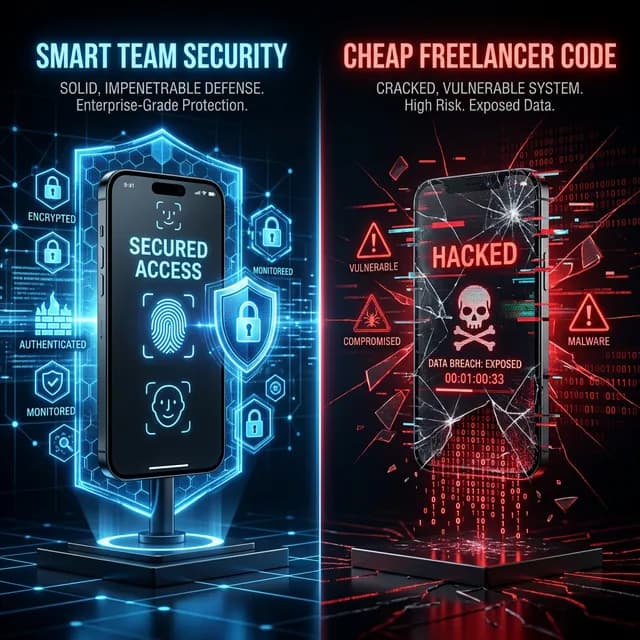
The "I Have a Guy" Syndrome
Many business owners, especially when launching their first mobile app, fall into a common trap. They want to test the market quickly, so they go to platforms like Upwork or Freelancer and hire a solo developer who promises to build an "Uber clone" for $2,000.
The app gets delivered. It looks fine. But under the hood, it's a ticking time bomb.
Building an enterprise mobile application isn't just about making buttons look pretty. It's about protecting user data, securing API endpoints, and encrypting local storage. At Smart Team, we frequently rescue businesses after their "freelancer apps" get hacked. Here is the difference between enterprise-grade security and a quick gig.
Enterprise Security vs. Cheap Code
| Vulnerability Area | Smart Team (Enterprise Grade) | Solo Freelancer App |
|---|---|---|
| API Keys | Secured in backend vaults | Hardcoded in the mobile app |
| Data Storage | Encrypted SQLite (SQLCipher) | Plain text local storage |
| Authentication | Biometrics + Token Expiration | Basic passwords, no session limits |
| Code Obfuscation | Advanced ProGuard / DexGuard | None (Easily reverse-engineered) |
| Testing | Automated Penetration Testing | Manual "It looks like it works" |
1. The Hardcoded API Key Disaster
The most common mistake we see in cheap apps is placing secret API keys (like payment gateway keys or database credentials) directly inside the app's code. Anyone with a basic decompiler can download the app, extract those keys in 5 minutes, and drain your funds or steal your users' data. We never store secrets on the client side; we use secure middleware architectures.
2. Reverse Engineering
Did you know that an Android APK or iOS IPA can be easily reversed back into readable code? If your app contains proprietary algorithms or sensitive logic, a competitor can simply steal it. Smart Team employs comprehensive code obfuscation and anti-tampering techniques, making the app essentially unreadable to malicious actors.
3. The Lack of Continuity
What happens when a zero-day vulnerability is discovered in the framework your app was built on? Will that freelancer from six months ago proactively patch your app? Unlikely. Security is a continuous process, not a one-time deliverable. We provide vigilant, ongoing monitoring and instantaneous security patches.
Reputation is Expensive
If a user's credit card or personal information is leaked from your app, the fines are heavy, but the loss of trust is fatal. You can't put a price on peace of mind.
Don't gamble your brand's reputation with unverified, solo developers. Build it right, build it secure, and build it with a team that treats your app's security like a bank vault.