
Headless and combined platforms: architecture trade-offs
What does this article explain?
Headless separates content or commerce services from the interface. Compare editorial workflow, integrations and operating complexity against a combined platform.
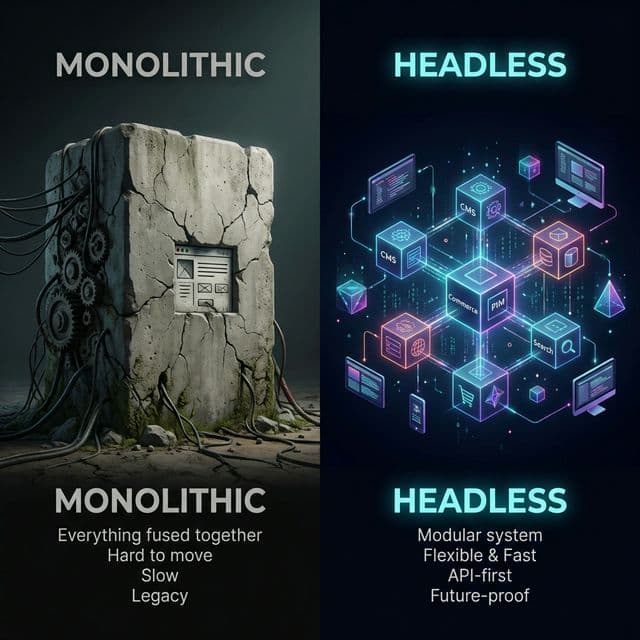
The "Everything in One Box" Trap
For years, building a website meant using a "Monolithic" system. Think of it like a car where the engine, the seats, and the tires are all welded together into one piece. If you want to change the radio, you have to take the whole car apart.
This is exactly how platforms like classic WordPress or old Magento work. The front-end (what users see) and back-end (where data lives) are fused together. It’s simple at first, but as you grow, it becomes a nightmare.
Enter: The Headless Revolution
At Smart Team, we don't build "boxes." We build modular ecosystems. The "Headless" approach means we cut the "head" (the user interface) off the "body" (the database).
They communicate via APIs. This might sound like more work, but for a business that wants to lead, it’s a superpower. Here’s why it's a human-centric necessity:
1. Speed That Feels Instant
In a Monolithic system, when a user loads a page, the server has to process everything at once. It’s heavy. With Headless, the front-end is pre-built (using tech like Next.js) and served via global networks. The user clicks, and the page is just there.
2. Security That Breathes Easy
When your database and your public website are the same thing, a hack on the front-end means your data is gone. In a Headless setup, the back-end is hidden. Even if someone tries to mess with what people see, your actual customer data is safe behind a secure API.
3. Scalability Without the Headache
Want to add a mobile app? Or a smartwatch notification? With Monolithic, you’d have to build everything from scratch again. With Headless, the "body" stays the same. You just attach a new "head."
Digital Freedom
Choosing between Headless and Monolithic isn't just a technical choice; it’s a business strategy. Do you want to be stuck with a system that slows you down every time you want to innovate? Or do you want a flexible architecture that grows as fast as your ideas?
At the end of the day, your customers don't care about the tech names—they care about the experience. And the best experiences in 2026 are built Headless.