
Financial software compliance in Saudi Arabia and the UAE
What does this article explain?
Financial software needs a review of the operator, activity and market rules. Platform origin alone does not establish compliance or replace required authorization.
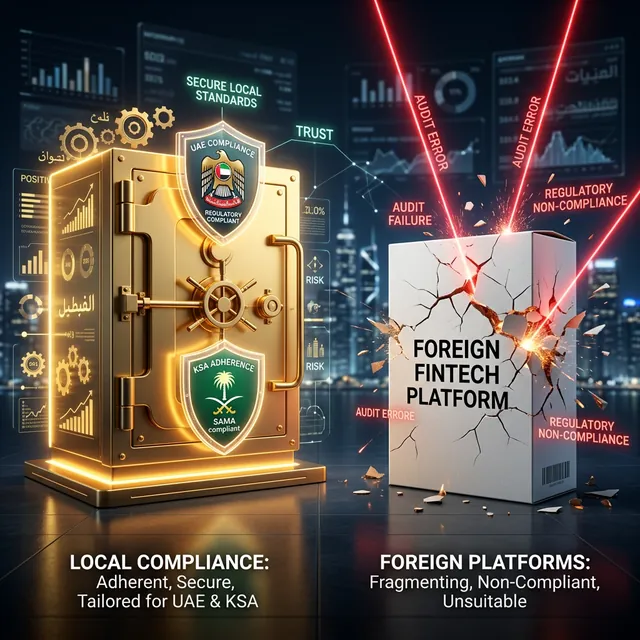
The Million-Dirham Mistake
The fintech scene in Riyadh and Dubai is exploding in 2026. Naturally, many startups try to take the fastest route to market: they buy a generic, foreign "white-label" financial software and slap their logo on it. It looks great on demo day. But then, the Central Bank audit happens.
Data sovereignty laws, KYC (Know Your Customer) regulations, and Anti-Money Laundering (AML) reporting in the UAE (CBUAE) and Saudi Arabia (SAMA) are incredibly strict. A generic platform built for the UK or US market will not save you. In fact, it might get you shut down.
At Smart Team, we build fintech infrastructure that is native to the region. We don't just write code; we write compliant code. Here is how local custom solutions compare to generic foreign platforms.
The Compliance Reality Check
| Compliance Area | Custom Regional Fintech (Smart Team) | Foreign White-Label Software |
|---|---|---|
| Data Sovereignty | 100% Data stays inside UAE/KSA borders | Data bounces across global servers |
| Local Integrations | Native Nafath, UAE Pass, Absher | Clunky third-party verifications |
| Audit Trails | Built to CBUAE/SAMA exact standards | Generic logs (Often fail local audits) |
| Sanctions Screening | Integrated with regional watchlists | Focuses only on OFAC/Western lists |
| Language Support | Right-to-Left Arabic logic native | Afterthought translation bugs |
1. The Data Sovereignty Trap
If your financial application processes a transaction in Dubai, the data regarding that citizen cannot legally chill on a server in Frankfurt. Foreign platforms often have complex, multi-region cloud setups that are very hard to isolate. Smart Team deploys our fintech solutions strictly on local approved infrastructure (like local AWS regions, Alibaba Cloud in KSA, or local data centers) guaranteeing absolute data residency compliance.
2. The Identity Friction (Nafath & UAE Pass)
A foreign system handles identity verification by asking for a passport scan and a selfie—a process that takes 48 hours for manual review. A locally designed system integrates directly with Nafath (KSA) or UAE Pass (UAE). The user authenticates in 5 seconds. If you don't have this, your customer acquisition cost will skyrocket due to drop-offs.
3. Real-Time Regulatory Changes
The regulatory landscape in the GCC moves fast. When SAMA issues a new circular requiring a change in how transaction limits are calculated, a global software company isn't going to rewrite their core code just for you. With a custom local partner, your system adapts to new local laws in days, not years.
Protect Your License
Getting a fintech license in the UAE or KSA is one of the hardest things a founder can do. Don't risk losing it by running your operations on software that treats local compliance as an "add-on feature."
If you are serious about building a financial institution in the Middle East, you need software built natively for the Middle East.